

Dhading, Rajan Thapa
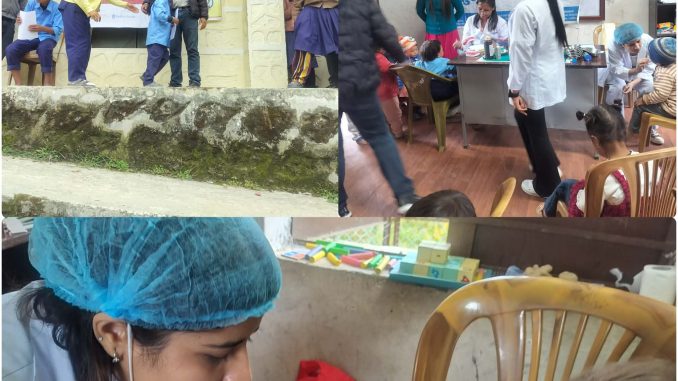
The school-level integrated health and dental camp conducted in the remote Himalayan settlements of Dhading was not limited to just a treatment program, it has emerged as a deep message of hope, compassion and humanity for the children living in pain and the local community.
Organized by Rubi Valley Rural Municipality and Khaniyabas Rural Municipality, with financial and technical support from Sechen Karuna and technical cooperation from Om Samaj Dental Hospital, the camp provided health services to 7 schools in Rubi Valley and 14 schools in Ward No. 2, 3 and 5 of Khaniyabas Rural Municipality.
More than 1,300 students and teachers have benefited from the camp. Dental check-ups, tooth extraction and filling services, eye check-ups, ENT services, nutrition tests, anemia tests and general health check-ups were provided.
Many health workers were emotional after reaching the remote villages and providing services. Some children had seen a dentist for the first time in their lives, while others had been forced to go to school with unbearable toothache for years.
Rajan Thapa, a social activist who was actively involved in this campaign, said with emotion,
“It was heartbreaking to see the condition of those children in remote villages. Seeing the smiles on the faces of children who had endured unbearable pain at a young age after treatment made me realize that service is the greatest religion in life. We have not only treated them, but also tried to share their pain.”
Thapa added,
“In our experience so far, we have seen dental problems in about 85 percent of children. It is truly necessary to conduct such camps every year now. According to the locals, Sechen Karuna has supported the work that the local government has not been able to do. For many, this organization has become a god.”
The program’s Program Coordinator Tek Khadka said that the lack of health services in remote areas is still serious,
“When I saw the condition of the children in the village, I realized that there is still a lot of work to be done. In some places, even basic health services have not reached. In such a situation, it is not only our responsibility to reach the village and provide services, but also our duty to humanity.”
Similarly, Sechen Karuna’s Program Manager Dipendra Pant said that this campaign has instilled hope in the rural community. He said,
“When a child smiles and says thank you after treatment, that moment we feel that all our hard work has been successful. Although providing services in remote villages is challenging, the happiness of the citizens there is our greatest achievement.”
Health and Sanitation Officer UN Tamang said emotionally, mentioning that dental problems are terrible in rural areas,
“Many children are coming to school despite the pain. The smiles they give after treatment have inspired us to serve more. This campaign has sent a message that citizens of remote villages should also get easy health services.”
Local parents and teachers have expressed happiness that free health services have reached remote areas. They have urged for the continuation of such programs.
This campaign has also raised a serious question — why has the state not yet reached such villages? But this camp has become proof that even in difficult circumstances, there are still hands that reach out to villages with a sense of humanity.
Today, not only has treatment been provided in those villages, hope has been born, faith has been awakened, and smiles have returned.