
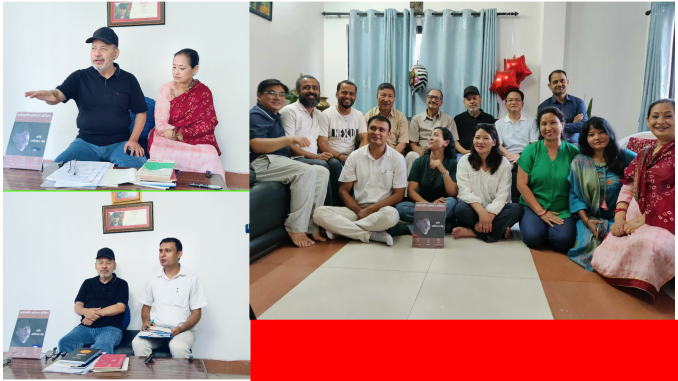

Kathmandu, Koteshwor — The fourth edition of the literary series organized by the Bartaman Kavita Samuha was held in Kathmandu, bringing together senior poet Avinash Shrestha and emerging writers in a program dedicated to intergenerational literary dialogue and exchange.
The event focused on the importance of transferring knowledge, experience, and creative values from senior literary figures to younger generations. Organizers stated that the program aims to strengthen respect for senior writers while encouraging meaningful dialogue within Nepal’s literary community.
At the opening of the program, Bartaman Kavita Samuha representative Bishwa Sigdel highlighted the relevance of such interactions, noting that they help bridge generational gaps in literature. He emphasized that the struggles and achievements of senior writers offer inspiration and guidance for younger poets and writers. He also mentioned that previous editions of the series had featured Sneh Sayami, Shyamal, and Laxmi Mali.
Senior poet Avinash Shrestha, known for his progressive and realist literary voice, shared insights from his long creative journey. His writing, which often reflects social inequality, labor struggles, and human suffering, has established him as a significant figure in modern Nepali poetry. He is recognized as the first poet in Nepali literary history to consciously and systematically write eco-poetry, making a significant contribution to environmental literature in Nepal.
Shrestha spoke about his early literary experiences in Guwahati, Assam, his association with poet Haribhakta Katuwal, and the challenges faced by Nepali-speaking communities in India. He also reflected on his literary journey in Nepal, including his interactions with fellow writers such as Bishnubibhu Ghimire, and offered critical observations on contemporary Nepali literary practice and criticism.
During the event, he recited selected poems, including Fark and Kunni Kun Aparichit Gaunki Nain Tara Baruwa, which were well received by the audience.
Following his presentation, a poetry reading session was held featuring several poets, including Bishnubibhu Ghimire, Suraj Parajuli, Keshav Bhattarai, Umesh Akinchan, Dhir Kumar Shrestha, Chandra Bahadur Lama, Premila Rai, Prajwal Adhikari, Bishwa Sigdel, Rami Priya, and Shakuntala Joshi.
The program also featured international participation from Bangladeshi poet and writer Senjuti Barua, who presented her works in multiple languages, including a Nepali translation of her poem Mahasagar. Her participation added a cross-border dimension to the literary gathering.
Participants described the event as a meaningful platform for literary exchange, stating that literature extends beyond books and remains a living tradition sustained through dialogue, experience, and continuous transmission. The Agrajsanga Bartaman Kavita series was highlighted as an important initiative fostering creative connection, mutual respect, and knowledge-sharing within Nepal’s contemporary literary scene.